
Signatures
of
Freedom:
Portraits of the Signers of the
Declaration of Independence
Welcome
"Signatures of Freedom: Portraits of the Signers of the Declaration of Independence" is a distinctive 2026 commemorative edition that combines the beauty of a collectible book with the functionality of a year-round calendar. It can serve as an illustrated brief history or be displayed as a wall calendar for the entire year.
The book provides a visual exploration of America’s founding, showcasing images of restored rare engravings and lithographs, along with brief biographies of all 56 signers of the Declaration of Independence. Each month features one of the thirteen original colonies, with designs commemorating the nation’s 250th anniversary and the enduring ideals of liberty and unity.
This product merges art, history, and practicality, making it ideal for history enthusiasts, collectors, and anyone honoring America’s heritage in 2026.
The book includes iconic works by artists such as Frederick Girsch and Ole Erekson, shedding light on how America’s founders were viewed by their contemporaries. Frederick Girsch’s famous engraving, based on John Trumbull’s painting, has become a lasting symbol of American history, even appearing on U.S. currency and stamps for generations, including the back of today’s $2 Federal Reserve Note. The book examines this iconic engraving, describes the arrangement of the figures in the scene, highlights the names of five influential patriots who inspired independence but did not sign the Declaration, and presents portraits of the thirteen signers absent from the vignette.

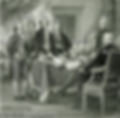
The Declaration of Independence.
Engraved by Frederick Girsch after the painting by John Trumbull, produced circa 1863 by the American Bank Note Company, New York.
About the Book
Exploring Historical Mystery
Deciphering an Iconic Engraving:
A Window into History
The iconic Declaration of Independence vignette was created in 1863 by engraver Frederic Girsch (1821–1895) while working at the American Bank Note Company on the $100 bill. This remarkable design was hand-engraved on a steel die measuring just 3 by 6 inches. The compact size of these dies served as an advanced security feature in early banknote printing, making them extremely difficult to counterfeit. The vignette, produced as part of the National Bank Notes series for the Raleigh National Bank in North Carolina, was inspired by John Trumbull’s painting The Declaration of Independence, July 4, 1776. Despite its title, however, the vignette actually depicts the moment of June 28, 1776, when the Committee of Five presented the first draft of the Declaration to the Second Continental Congress.
The Scene Unveiled:
Who’s Who in the Vignette
The scene at Independence Hall’s Assembly Room shows the presentation of the Declaration of Independence. At the center, the Committee of Five—John Adams, Roger Sherman, Robert Livingston, Thomas Jefferson, and Benjamin Franklin—steps forward as the creators of this historic document. Thomas Jefferson, the main author, offers the draft to John Hancock, president of the Continental Congress. Hancock, whose figure is deliberately larger than the others, draws attention and emphasizes his important role in this moment. Around the presentation, a diverse group of congressmen watches—some seated, others standing—creating a balanced horizontal composition. This arrangement highlights both the delegates’ crucial roles and the collaborative effort of the states. The scene includes 48 figures: 43 signers of the Declaration and five patriots—George Clinton, Robert R. Livingston, Thomas Willing, Charles Thompson, and John Dickinson—who decided not to sign for various reasons.
The Thirteen Colonies
Together Strong, Forever Free
A Nation Forged in Unity
At the start of the American Revolutionary War, the thirteen colonies were separate entities, functioning mostly as independent communities rather than a unified nation. Yet a rising revolutionary spirit developed, driven by collective opposition to British policies such as the Stamp Act (1764), the Townshend Acts (1767), and the Tea Act (1773). The taxes on printed materials and imported goods caused widespread anger and increased calls for self-governance, reflecting a growing desire for independence and local control. Influential writings like John Dickinson’s Letters from a Farmer in Pennsylvania helped unite colonists in boycotting British goods. These grievances merged into a unified movement, leading to the creation of the Continental Congress and the Continental Army, initially composed of local militias. Thanks to General George Washington’s inspiring leadership, this diverse force was unified into a formidable fighting entity. His ability to motivate and support troops, especially during difficult times, was crucial to America’s victory in the Revolutionary War. The triumph was driven by key factors: fighting on familiar terrain, vital foreign aid (particularly from France), a strong commitment to independence, and the strategic use of unconventional tactics. Meanwhile, the British faced significant challenges, including overstretched supply lines, difficulties distinguishing soldiers from civilians, and waning public support for the war. America’s victory was a remarkable achievement driven by teamwork, persistence, and a strong dedication to freedom, resulting in significant successes.
The Recruit.
Engraved by the National Bank Note Company, New York, around 1870, a predecessor of the American Bank Note Company.
Washington at Encampment.
Engraved by Luigi (Louis) Delnoce after a painting by
F.O.C. Darley, around 1862, American Bank Note Company.
First in War, First in Peace, and
First in the Hearts of His Countrymen
On July 4, 1776, while the Continental Congress approved the Declaration of Independence in Philadelphia, George Washington was in New York, diligently preparing his troops for an expected British attack. Days later, after receiving a copy of the Declaration from John Hancock on July 6, Washington ensured the Declaration’s message reached his men. On July 9, the Declaration was read aloud to his army, marking a pivotal moment in their fight for independence. This powerful message of natural rights and self-governance deeply resonated with the soldiers, inspiring them and giving them a clear purpose for their future sacrifices. Washington understood the importance of inspiring his troops—especially the newer recruits—and helping them see the significance of their fight for a free nation. To do this, he distributed copies of the Declaration to all Continental Army generals and instructed chaplains to explain the Declaration’s key principles. This strong leadership, driven by the impact of the Declaration, helped unite the diverse colonial militias into a united and effective fighting force.
A Legacy of Sacrifice
Thomas Paine was a key figure in the American Revolution whose writings significantly shaped the nation’s sense of identity. His beliefs are reflected in his powerful quote: “I prefer peace. But if trouble must come, let it come in my time, so that my children can live in peace.” This statement, from Paine’s series of pamphlets, The American Crisis, written during the Revolutionary War, not only shows his desire for peace but also his willingness to sacrifice for the future well-being of the next generation. Paine’s writings argued for full independence from Britain, emphasizing the colonies’ natural ability to govern themselves and succeed on their own. He strongly rejected the idea of a small island ruling a vast continent and believed that breaking away from Great Britain would help America avoid becoming involved in European conflicts. Paine’s clear and inspiring writing made complex ideas easy for ordinary colonists to understand, highlighting the urgent need for independence. His straightforward language and emotional appeals resonated with a broad audience, making his beliefs highly popular and influential.
To Arms! Engraved by Luigi (Louis) Delnoce and Charles Burt, circa 1882, American Bank Note Company.
Uncovering Historical Legacies
Preserving Signers' Legacies
Ole Erekson’s 1876 lithograph, Portraits & Autographs of the Signers of the Declaration of Independence, is an impressive patriotic artifact created for the United States Centennial. It features all 56 signers, each with a portrait and their actual signature, combining artistic visuals with historical details.
Created by a Norwegian-born artist and former Civil War-era photographer, this work serves as an essential educational tool reflecting a national celebration of American founding history. It is a testament to 19th-century commercial printmaking, which combined meticulous draftsmanship with mechanical reproduction techniques to create a detailed, complex historical print.
Portraits & Autographs of the Signers of the Declaration of Independence. Lithograph by
Ole Erekson, 1876, Library of Congress Prints & Photographs Division, LC-DIG-ppmsca-07837.
Massachusetts: The Cradle of Liberty
Massachusetts, often referred to as the “Cradle of Liberty,” played a pivotal role in sparking the American Revolution. Boston’s Faneuil Hall, a vital meeting place, earned this title by hosting passionate rallies and spirited discussions that fanned the revolutionary spirit. Although the Declaration of Independence was drafted in Philadelphia, the roots of the independence movement’s actions and ideals can be traced back to Massachusetts. Groups like the Sons of Liberty vigorously opposed British laws such as the Stamp Act and the Tea Act, embodying the cry of “No taxation without representation.” This resolute resistance was energized by a network of dedicated leaders, including Samuel Adams and John Hancock, who spread revolutionary ideas and worked to unite the colonies. Events such as the Boston Tea Party and the Battles of Lexington and Concord in April 1775 underscored Massachusetts’s role as the pivotal spark that ignited the American Revolution.
John Adams
John Adams (40 years old at signing), a dedicated lawyer and advocate for independence, served on the committee that drafted the Declaration of Independence and played a key role in revising it after Thomas Jefferson’s initial draft. During the Revolutionary War, Adams worked as a diplomat in Europe, tirelessly securing foreign loans and negotiating peace with Britain. After the war, he became the first vice president and the second president of the United States. Notably, he was the first Harvard graduate to hold the presidency. His son, John Quincy Adams, later served as the sixth president. John Adams died on July 4, 1826, at age 90, exactly 50 years after the Declaration of Independence, and on the same day as Thomas Jefferson. Adams’s death occurred in Quincy, Massachusetts, while Jefferson died at Monticello, Virginia.
Commemorating the 250th Anniversary of the Declaration of Independence
United We Stand, Divided We Fall

To honor the nation’s 250th anniversary, the book features commemorative designs. Each of the thirteen original colonies is represented by a unique seal that combines the state’s motto with the timeless phrase “United We Stand, Divided We Fall.” These emblems celebrate both the individuality of each colony and its shared achievement of declaring independence. The narrative concludes with a powerful symbol of unity: a national design honoring all fifty states, displaying fifty stars and the motto “In God We Trust,” a tribute to the enduring strength of the Union established in 1776. Complementing these symbols, a special 2026 commemorative calendar blends art, history, and biographies, with each month illuminating the spirit of the Revolutionary era and the character of the remarkable people who shaped it.
The People's Anniversary:
50 States, 250 Years

USA 250
Each element of the USA-250 design gracefully combines history, symbolism, and elegance—honoring 250 years of American heritage.
Design Overview
The number “250” is prominently displayed at the center of the emblem, encircled by 50 stars—each representing a state—making it the primary focus of the stamp point.
The inspiring title, “United We Stand, Divided We Fall,” surrounds the emblem above and below, instantly emphasizing themes of unity and resilience.
The nation’s name and founding date—“United States of America, July 4, 1776”—ground the design in its historic roots.
The phrase “In God We Trust,” our longstanding national motto, highlights tradition and shared values.
A “Semiquincentennial 250” imprint celebrates the milestone, featuring well-balanced sections that enhance clarity and visibility.
Symmetrical scrollwork, lace, and rosette motifs softly border the composition, combining classic American engraving with modern design for a unified, elegant appearance.
A Legacy of Sacrifice
To Arms! Engraved by Luigi (Louis) Delnoce and
Charles Burt, circa 1882, American Bank Note Company.

Our Story:
Signatures of Freedom
Where history meets design.
Signatures of Freedom is our studio’s tribute to America’s journey toward liberty—told through art, photography, and visual storytelling. We bring the revolutionary ideals of 1776 into the modern era by restoring portraits, photographing engravings, and creating original imagery that honors the individuals who shaped a nation. Each piece in our collection reflects the courage and conviction that continue to define the American spirit.
Our Artistic Philosophy
We believe the most powerful stories are created where vision and craftsmanship come together. We don’t just design or take pictures—we craft cohesive visual experiences that tell a story. Our work is a conversation between fine art, authentic photography, and thoughtful design. Every project is filled with depth, clarity, and artistic purpose, making history feel alive and present in every detail.
A Glimpse Inside the Book
The Book's Layout
Iconic Works and Lasting Symbols
The book’s layout begins with the January design: an introduction to the collection, showcasing a restored impression of the “Patriot” vignette engraved by the American Bank Note Company circa 1890, and presenting a unique design for each of the thirteen founding colonies. The signers' authentic signatures are displayed in historic order, accompanied by their names and colonial affiliations.
The narrative continues in February with New Hampshire, the first colony to sign. This spread features a stunning restored engraving of Independence Hall, produced by the Franklin Bank Note Company around 1843, and the portraits of New Hampshire’s three signers, set in oval frames on an intricate lacework background, along with their signatures, life stories, and a summary of the state’s contributions.
At its core, the book features a striking two-page spread that showcases all 56 signers. It functions as a key not only to identify each figure in the famous scene but also to highlight the five patriots who did not sign for various reasons. Additionally, it provides restored portraits of the 13 signers omitted from the Trumbull painting and the Girsch vignette. These two works—the Frederick Girsch vignette and Ole Erekson's lithograph—provide the visual and historical foundation for this commemorative edition.
The following months continue to unveil each state’s story, enriched by photographs of 13 restored engravings, the complete gallery of all 56 signers’ portraits from Erekson’s lithograph, and unique designs commemorating our nation’s 250th anniversary.

January 2026
United We Stand, Divided We Fall

February 2026
Independence Hall: The Nation’s Birthplace

Center Spread
The Scene Unveiled:
Who’s Who in the Vignette

June 2026
The Making of a Masterpiece
Rita Melamud
Hi, I’m Rita Melamud — a graphic designer and photographer passionate about history and storytelling. I enjoy restoring historic engravings and working with microphotography, which helps me vividly bring the beauty and details of the past into the present. Over the years, I’ve had the privilege of creating art, design, and photography for Bucks County Community College and The Franklin Mint, and of designing USPS Commemorative Panels while working at the American Bank Note Company.
My latest project, Signatures of Freedom: Portraits of the Signers of the Declaration of Independence, is a passion project that combines my fascination with American history and my skill for visual storytelling. When I’m not researching or photographing historical prints, I enjoy exploring new ways to blend art, storytelling, and history into meaningful creative endeavors.